Context #
In rapid software development, a major bottleneck is the scarcity of staging environments. Developers often queue up to test their features on a single "Staging" server, leading to conflicts, delays, and "it works on my machine" syndromes.
This project involved building an Internal Developer Platform (IDP) that treats environments as disposable commodities. By abstracting the complexity of Kubernetes and AWS, we empowered developers to spin up a full-stack, isolated replica of production with a single API call (or Slack command). Crucially, these environments are "ephemeral"—they come with a built-in Time-To-Live (TTL) and auto-destruct after 4 hours, preventing the cloud bill from exploding due to forgotten resources.
Client identity withheld under NDA. Architecture and outcomes described as delivered.
Constraints and objectives #
- Developer Autonomy: Remove the DevOps team from the critical path. Developers can self-provision testing grounds instantly without raising a ticket.
- Resource Isolation: Guarantee that Feature A testing never breaks Feature B testing by giving every branch its own dedicated Kubernetes Namespace and URL.
- Cost Containment: Enforce strict "leases" on infrastructure. If an environment isn't actively being used, it shouldn't exist.
- Drift Elimination: Every ephemeral environment is spun up fresh from the latest Infrastructure-as-Code definitions, ensuring testing always happens on "clean" infrastructure.
Architecture and implementation #
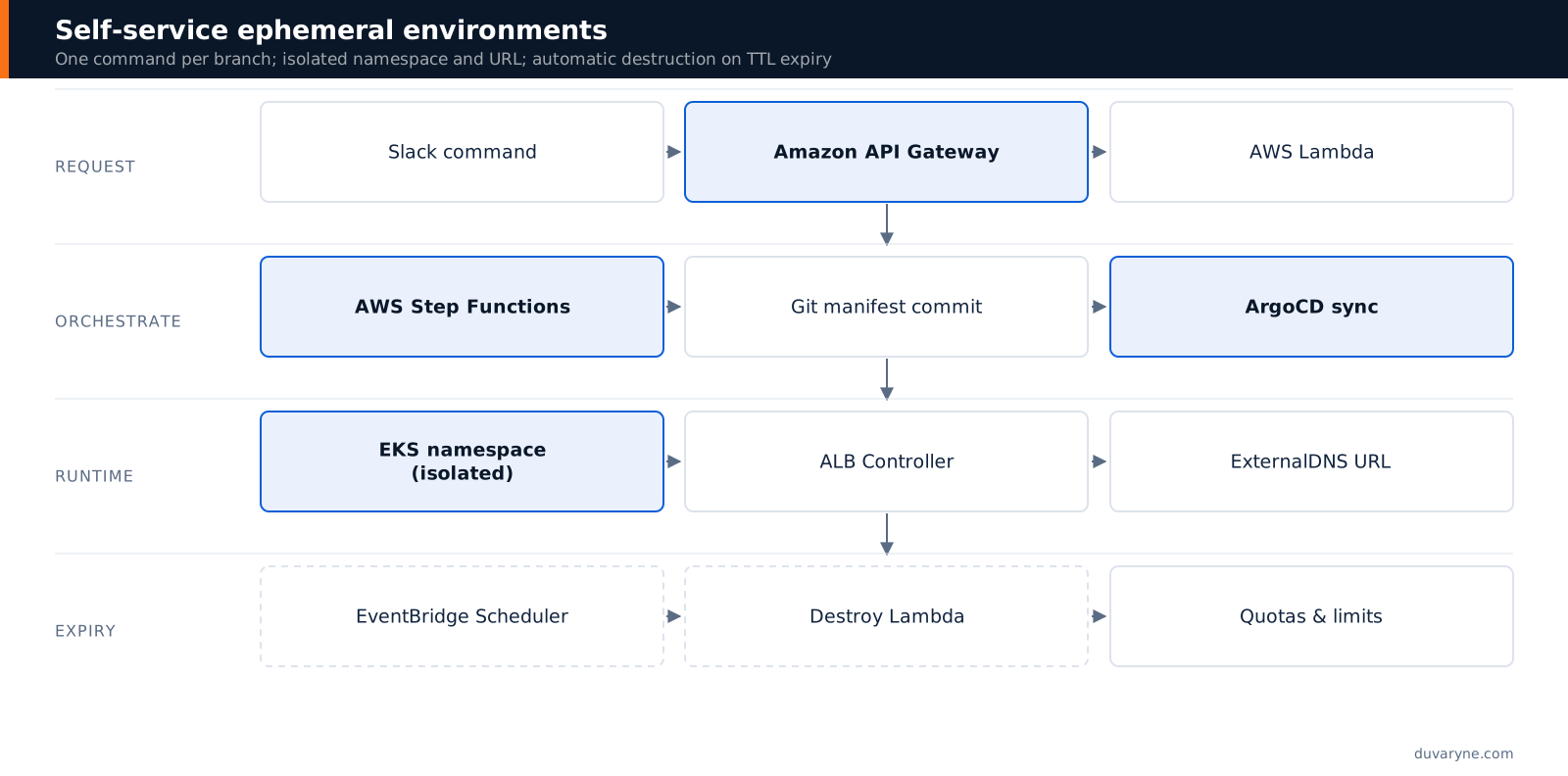
- Interface: Amazon API Gateway triggering AWS Lambda functions.
- Workflow Orchestration: AWS Step Functions to manage the provisioning lifecycle (Create Namespace -> Deploy App -> Create Ingress -> Health Check).
- Container Orchestration: Amazon EKS (using Namespaces for multi-tenancy).
- Traffic Routing: AWS Load Balancer Controller + ExternalDNS to automatically generate dynamic URLs (e.g.,
feature-login-update.dev.company.com). - Automation Logic: Amazon EventBridge Scheduler to trigger the "Destroy" Lambda when the TTL expires.
- Methodology: GitOps (ArgoCD): The "creation" process simply adds a temporary Application manifest to the Git repo, which ArgoCD picks up and syncs.
- Namespace-as-a-Service: Leveraging Kubernetes quotas and limits to ensure one developer cannot hog cluster resources.
Outcomes #
- 300% Increase in Deployment Velocity: Developers no longer wait for "Staging" to be free. Multiple features are tested in parallel.
- 40% Reduction in Non-Production Cloud Spend: By ensuring dev environments only run during working hours and auto-terminate, we eliminated "zombie" resources.
- Standardized Quality: Every environment is identical to production, significantly reducing bugs that typically appear only after deployment.
- Zero-Touch Management: The system handles over 50 environment creations/destructions per week without any manual intervention from the Ops team.
What we would do differently #
A four-hour TTL is the right default and the wrong hard limit. Developers learned to re-request environments mid-debug, which is friction we introduced ourselves; an extend command would have cost an afternoon to build and saved more than that in the first month. We would also seed environments with a realistic anonymised dataset from the start — an isolated namespace with an empty database catches structural bugs but not the ones that only appear at production data volumes.