Context #
Deploying a web presence requires more than just installing a server; it demands a configuration optimized for speed, security, and reliability. This project focused on architecting a production-ready Static Web Host using the industry-standard Nginx engine on a hardened Linux kernel.
Beyond simple content serving, the focus was on establishing a "Secure-by-Default" posture. This involved configuring rigorous DNS routing policies and implementing an automated SSL/TLS certificate lifecycle, ensuring that all data in transit is encrypted. The result is a robust, low-latency web endpoint capable of handling high concurrency while maintaining an A+ Security Rating.
Client identity withheld under NDA. Architecture and outcomes described as delivered.
Constraints and objectives #
- Optimized Content Delivery: Configure Nginx for high-throughput static asset serving, utilizing gzip compression and efficient caching headers to minimize latency.
- Identity & Routing: Establish authoritative DNS records (A/CNAME) to ensure rapid global domain resolution and seamless user connectivity.
- Encryption Everywhere: Enforce HTTPS-Only traffic policies using TLS 1.3 and Let's Encrypt, preventing "Man-in-the-Middle" attacks.
- Server Hardening: Disable insecure protocols and default server banners to reduce the attack surface against potential reconnaissance.
Architecture and implementation #
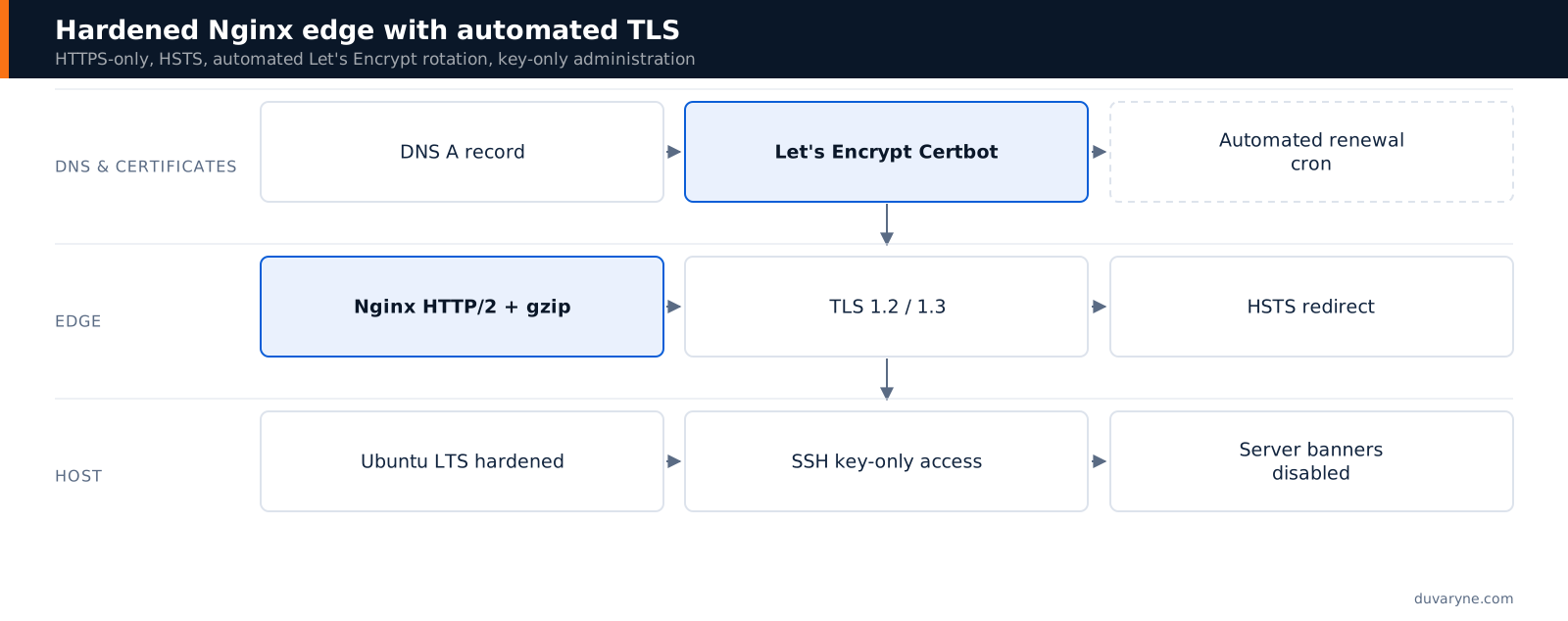
- Web Engine: Nginx (Configured as a high-performance static server).
- Operating System: Ubuntu LTS (Hardened with SSH Key-only access).
- Domain & Network: DNS Management (A Record propagation), TCP/IP flow control.
- Cryptography & Security: Let's Encrypt (Certbot) for automated certificate rotation, OpenSSL for handshake verification.
- Protocols: HTTP/2 for multiplexing, TLS 1.2/1.3 for encryption.
- Methodology: Secure Administration: implementation of SSH key pairs for remote server management, disabling root password login.
- DNS Validation: utilized
digandnslookupto verify global propagation and TTL settings.
Outcomes #
- Grade "A" SSL Security: Achieved top-tier security scoring on Qualys SSL Labs by configuring strong cipher suites and implementing HSTS (HTTP Strict Transport Security).
- Zero-Touch Certificate Renewal: Implemented automated cron jobs (Certbot) to handle SSL renewals, eliminating the risk of certificate expiration downtime.
- High Availability: Delivered a stable, publicly accessible web endpoint with sub-millisecond response times for static assets.
- SEO & Trust Compliance: Ensured the domain is trusted by modern browsers (Chrome/Safari) by enforcing valid HTTPS connections, boosting search ranking potential.
What we would do differently #
Certbot on a cron job is correct but it is a single point of failure on a single host. We would move renewal to a process that can fail loudly — a monitored job with an alert on certificate age rather than on renewal failure, because a cron that silently stops running looks identical to one that has nothing to do. For anything carrying real traffic we would terminate TLS at a managed load balancer and keep the origin simpler.